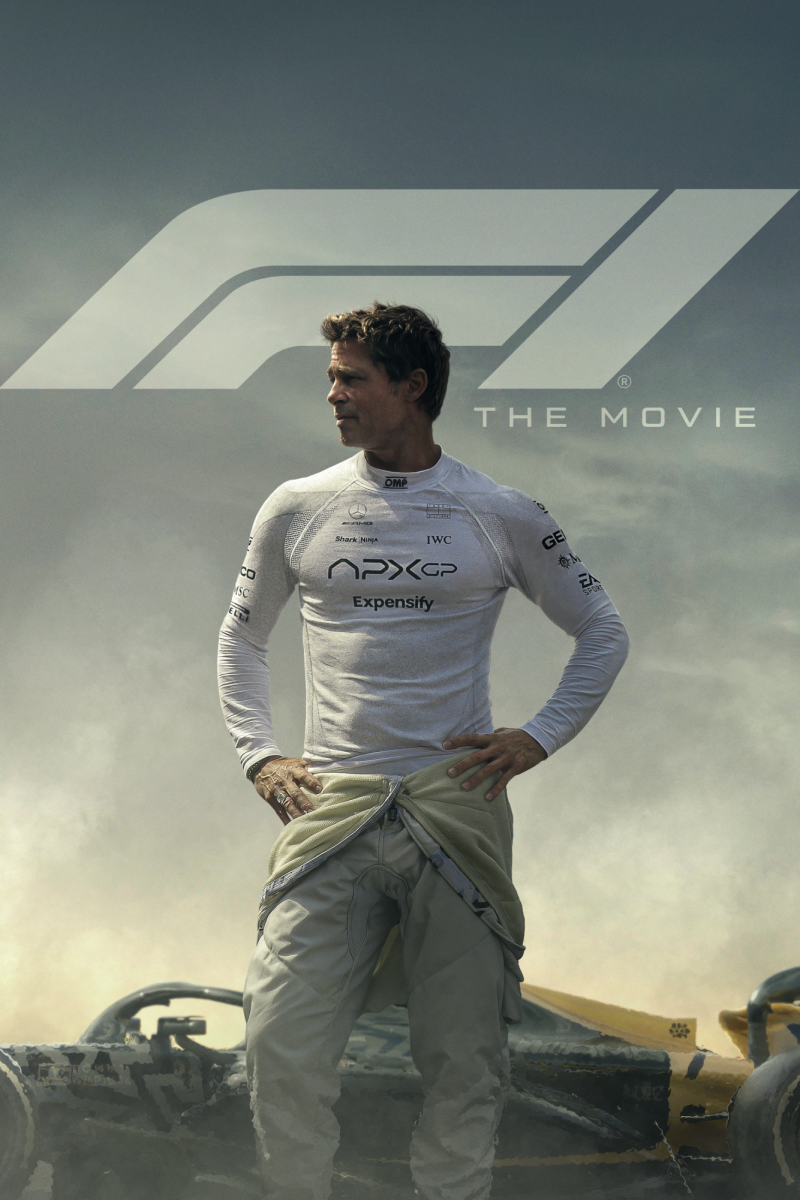
Who doesn’t love a good spectacle, and who doesn’t love a good race? These are the questions that 2025 summer blockbuster and Best Picture nominee “F1,” named after its subject of Formula One racing, asks.
F1 is marketed as a cinema spectacle, reminiscent of other genre classics, and it certainly delivers on this promise. Centering Sonny Hayes (Brad Pitt)’s return to Formula One racing after an early retirement, and his subsequent competition with younger racer Joshua Pearce (Damson Idris), the film hits all the beats of a classic sports comeback story. Sonny is a veteran cowboy with a work ethic while Joshua is an arrogant up-and-comer—can they find a way to work together?
For all its use of the cookie-cutter narrative structure, “F1” is groundbreaking in its cinematography and subject matter. It produces stunning visuals, makes use of its aesthetic advantages whenever possible, and is best watched in IMAX. Combined with the cast’s starpower and magnetic pull—Pitt and Idris are certainly easy on the eyes—it’s easy to get lost in the world of “F1.”
Once there, however, the world of “F1” does not seem particularly ripe for analysis. Its plotlines are cut and dry; Sonny wants to succeed, and so the journey continues, and everything else is extraneous and therefore treated as such. Sonny’s romance with colleague and engineer Kate McKenna (Kerry Condon) is inevitable and meaningless, shoehorned in for the sake of itself. There’s light lip service paid to misogyny in F1, as well as racism, but these discussions reek of necessity instead of a genuine interest in this complexity of Formula One racing.
Meanwhile, the movie’s predictable arc, at first quite charming, becomes lazy upon a rewatch. “F1”’s use of clichés isn’t intended to make one aspect of the plot more accessible, nor for effective payoff, and the film definitely does not attempt to deconstruct the structure it uses. It’s a cliché format for cliché’s sake, because it’s easy or because it makes money.
In the same vein, Pitt and Idris’ performances do little more than rely on the narrative beats concocted by their script writers, and as a result, their characters have no convincing emotional nuance. Even when their characters have opportunities for vulnerability and complexity, Pitt and Idris remain committed to the idea of their characters as paragons of unshakeable masculinity, and the movie suffers for it.
In the end, “F1” simply has nothing to say. It tries, for sure; the directors must think “F1” is about winners and losers, perhaps, or about hard work, or love, or some other trite theme that can be applied to any plot. But when it comes down to it, “F1” is a story told without intention or direction, a story told simply for the sake of accumulative storytelling.
It is under this gaze, with the purpose of the film laid bare, that its case for Best Picture falls apart.
There’s nothing wrong with a blockbuster film made for consumption by general audiences. In an increasingly disorienting news cycle, a little escapism is warranted. But the Oscars are a venue for rewarding excellence, not popularity. If they’re looking for a Best Picture, they ought to find another candidate.