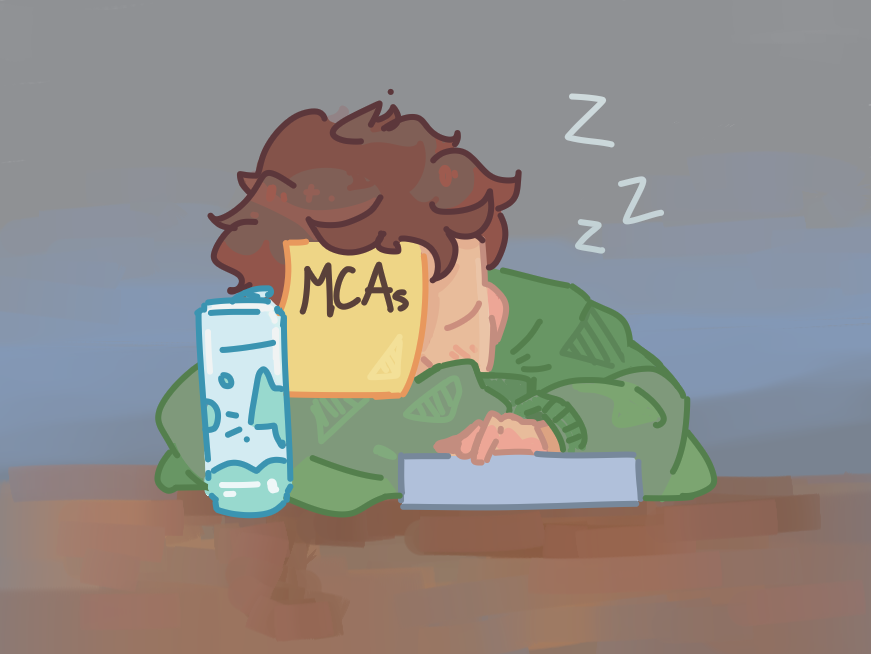

A stable classroom space is fundamental to creating a positive environment for both students and staff. But for over four dozen teachers at Edina High School, about an hour daily goes into moving between classrooms: time they could be using to answer student questions, prepare for their next class, or collect homework prior to the lesson. Meanwhile, plenty of space is poorly used in dozens of unnecessary flex spaces. For a well-funded school like EHS, having enough classrooms is nonnegotiable for the wellbeing of students and teachers.
The time it takes to physically move between classrooms doesn’t even include the time it takes to carry heavy equipment between rooms, manage storage of different projects, papers, or books, and duplicate labor-intensive classroom resources such as putting up multiple Word Walls or updating homework schedules on several whiteboards. Staff’s time is instead best used helping students. Teachers moving classrooms makes it impossible for students to clarify complex ideas, get quick feedback on a thesis, or just ask about when to make up a test.
“Nobody knows where to find me,” Sociology, U.S. History, and Criminal Law teacher Haydn Hewson said. “I can’t stay between classes because I have to go set up a new classroom.”
This is not an uncommon problem: about 50 teachers in a variety of departments have to switch classrooms, and it’s primarily teachers of core subjects such as English and social studies. Several of them have three or more classrooms to move throughout, some even on different floors. Hewson has to move between five different rooms and loses an hour every school day because of it. “My desk is in a break room where everyone eats lunch,” he said. “It’s embarrassing.”
The complicated storage for teachers leads to missing assignments and supplies. Moving classrooms also harms student-teacher relationships because staff can’t personalize their rooms, so students are unable to know their teacher’s hobbies or bond over common interests. Hewson frequently experiences these issues; moving between impermanent desks, he frequently loses tests, assignments, his slide clicker, and more. And when students point out something cool in his classroom that belongs to another teacher, he can’t connect with them about it. It’s unfair and unprofessional to both students and staff.
“I feel like I’m not really a teacher. I don’t have any of my supplies, I can’t organize my classroom the way I want it—the worst part? I feel like I’m being treated unprofessionally,” Hewson said. “I’ve been here for nine years and in any other profession, I’d have my own office and my own classroom.”
In the back hallway of the social studies wing, a few classrooms with noticeably abundant windows used to be flex spaces. According to Principal Paul Paetzel, flex spaces were added in the $60 million 2017 school redesign to provide “independent work spaces” as ninth grade was shifted from the middle schools to EHS. “It’s about strategy for learning,” Paetzel said. “What’s central to this is: should learning be student-led or teacher-led?” Only the aforementioned few social studies classrooms have been converted since.
Flex spaces hardly fulfill their intended purpose. Although they were added for the purpose of independent work, many of them are often either empty or used to hang out with friends during the day. Hewson said that the flex space now converted to fellow social studies teacher Sarah Steinman’s classroom was mostly used for smoking or other non-academic activities. There’s no reason why other flex spaces shouldn’t be transformed as well, especially as most teachers find them more problematic than helpful.
“They don’t care about teachers,” he said. “They have no respect for us professionally. They’re more interested in selling an idea to parents, who are their shareholders, and the school board, than they actually care about students and teachers.”
Hewson is fundamentally correct. Not including other staff, EHS has 113 teachers and only about 100 rooms, with around 30 that need special equipment or room design such as chemistry labs. Even if flex spaces provide some benefit for independent work time, it’s not nearly enough to outweigh the harms.
If EHS cares about their students and teachers, they should replace flex spaces with classrooms. For students, it would allow them to better connect with the people who teach them every day. For teachers like Hewson, not only would it allow them to save time, personalize their classrooms, store their materials reliably, and answer student questions, it would also show them greater respect as essential workers who shape student learning, lives, and personal growth.
This piece was originally published in Zephyrus’ print edition on Oct. 2, 2025