


The first time senior Juliet Heffelbower encountered artificial intelligence was in her freshman year when her friend told her ChatGPT was going to change the way students write essays.
“I was thinking in my head like, ‘No way, that’s crazy, it’s not going to happen,’” she said. “But it did.”
OpenAI’s ChatGPT, the most popular Large Language Model (LLM) in the world, introduced GPT-3.5 in November 2022, during current seniors’ freshman year. This research preview was the first chatbot widely available to the public, and, by February 2023, it had 100 million users.
Senior Derek Seymour said when ChatGPT was launched, he tried it right away.
“When it initially came out, people were much more bold with it, especially when detectors were still not great,” he said. “I saw a lot of my friends immediately start fully plagiarizing essays.”
Former Edina High School computer science teacher and current executive director of tech education initiative CreateMPLS Shannon Seaver said she feared students using ChatGPT and “not learning” in a January 2023 interview with Zephyrus.
“I’m concerned about kids who graduate,” Seaver said in the interview. “Did they actually earn graduation? Are companies hiring them thinking that they know how to code, and they don’t know? How will they perform? There’s many questions.”
It would not be until April 2023, the end of Heffelbower and Seymour’s freshman year, that Turnitin, the plagiarism detector teachers use, would release an AI detector.
During the time it took for Turnitin to release its AI detector, OpenAI also released the first widely available artificial intelligence (AI) art generator DALL-E 2. The program allows users to create images and art from prompts.
Art teacher Dalen Towne was first introduced to AI art generators in 2022 when she heard of a group of working artists who uploaded their art to a generator that made suggested improvements to their pieces. The artists later realized the AI would use their uploaded art without consent to generate new pieces.
“We’re on the cusp of a huge radical shift in the way people write and the way people create,” Towne said in a January 2023 interview with Zephyrus. “People right now are in shock about how to deal with it. I don’t think they realized it was going to go this quickly.”
Since then, students and staff have changed their approaches to AI use.
The ACT reported in June 2023 that 46% of surveyed students used AI for school assignments. As of May 2025, the College Board found that more than 84% of high schoolers in the country report using generative AI, even though two-thirds of them agree that overusing AI will make them over-reliant on the technology.
Heffelbower said she now notices her peers procrastinating their work and using AI to complete it, then cramming the material before tests.
Seymour, who said he started using AI during his sophomore year to guide research, said AI has become integrated with schoolwork. In his College in Schools Intro to Literature class, he noticed multiple students using AI on their assignments for varying purposes. He said some peers “fully plagiarized” essays while others “just used it for ideas.”
“I would say most seniors have at least looked at using AI on their essay,” Seymour said. “It’s definitely changed, compared to my sisters, who are a little bit older. They didn’t have access to it, and so they had a different experience.”
Most notably, Seymour said his older sisters learned better research skills and had to focus more on grammar and the “finer points” of writing.
Students themselves are divided about proper AI use. Senior Madison Bliss said she is against it because students “don’t do any creative thinking for themselves anymore.”
“It’s really taken over people’s thoughts and how to process things,” junior Olivia Stevens said. “Even if it’s simple things, they’re still like, ‘Oh, let’s see what ChatGPT thinks.’”
Junior Jack Boruta, though having never used AI before, believes that AI’s “greatest strength is its ability to sort through multitudes of data incredibly quickly,” enabling students to develop ideas they would not have come up with on their own.
Freshman Eli James said he saw more of his peers using AI “for good” to understand topics or outline essays and rarely saw them using it to cheat.
However, both James and Seymour said it was unclear in their classes what counts as cheating. James said he noticed that the way teachers talk about AI as “super bad” makes guidelines for acceptable AI use confusing.
Teachers and staff generally ban the use of AI in assignments due to the complexities of navigating academic honesty concerns.
“I want our students to stay on the path of integrity and be honest about their work and their learning,” Tess Bademan, head of the English department, said. “We want to avoid making it an issue that creates conflict and contention between teachers and students.”
Edina Public Schools teachers have an outline about generative AI in the classroom, and its goals is to assist educators with helping “students understand the basics of AI.” The outline suggests levels of responsible use, but this structure is not common in EHS classrooms.
Heffelbower said she believes incorporating more assignments that force students to “show more of [their] own thinking” could combat the overuse of AI.
“Some people are concerned about students knowing how to use AI so that they can be successful in their careers. Some people are concerned about AI and the opportunities for cheating it presents,” Bademan said. “So we’re trying to wrap our heads around all these different things.”
Towne bans AI in her classroom, whether for art references or writing, because she would rather have original “incomplete thoughts” than ideas that are “regurgitated.”
“They love it,” Towne said of her students’ thoughts on her classroom policy. “It builds up their self-confidence when you give them permission to be wrong.”
EPS’s Electronic Technologies Acceptable Use policy states students should be “honest, fair, and show integrity” about information and must “identify sources and test the accuracy of information.”
To uphold this policy, teachers use AI detectors when evaluating students’ writing. However, it has created an issue of false flagging, which is when AI detection tools incorrectly identify original writing to be generated by AI.
Boruta said he never had a problem with false flagging until this school year and found he has been flagged for assignments that require more professional, logic-based writing.
“I panic in those situations because I know I’m innocent, but I just don’t exactly know how to prove it,” he said. “Typically, I try to react by just reaching out as fast as possible and trying to just make it up with rewrites. It’s just more work on my behalf, but I’d prefer it over this kind of rift over the assignment.”
Even after Boruta makes up the assignments, he said he still feels like being flagged “decreases trust between me and my teachers.”
Stevens said her friends have written essays by themselves but received zeros because they were flagged for AI use.
“I feel like people now are getting over-worried about AI,” she said.
Many students said they were disappointed by the quick negative responses of staff to AI and believe there have been missed opportunities for the integration of AI into education.
“I feel like my teachers don’t really touch on AI as much as they should,” junior Sierra Lawrow said. “I also feel like incorporating AI for school usage is bound to happen.”
Lawrow and other students suggested that the district provide education for students about the challenges and merits of AI.
“Since it’s banned and it’s not taught, the only way you can use it is to cheat and to break the rules,” Seymour said. “If they taught us about AI and then said you can use it specifically in this way, I think more people would be inclined to use it productively, rather than use it to cheat.”
In recent years, stories about the effects of AI on the environment have also emerged. A 2023 research paper revealed that training OpenAI’s GPT-3 language model required 700,000 liters of clean freshwater total and is projected to account for billions of liters of water by 2027.
“I feel like not a lot of people know that the environment has this big negative effect, because I was talking to my friends about it, and all people are really hearing is how beneficial it is,” Lawrow said. “I do use AI, and it is really helpful, but just the lack of knowledge of the negative concepts is really startling.”
A large part of the environmental cost associated with AI lies within its data centers, which need to be cooled with freshwater and can strain local power grids. Deloitte, a professional service network, predicted that by 2035, data centers’ demand for AI will increase thirtyfold.
Senior Ash Kansara said that xe feels the rise in AI use could have catastrophic implications for climate change.
“Honestly, it makes me feel a little bit hopeless for the future,” Kansara said. “When I was littler, and I was told about climate change, I always used to think if I recycle enough, if I take care of things on my end, and other people try their best too, then it’ll all work out eventually. But it just makes me feel like the world doesn’t care enough to prevent the end of the world.”
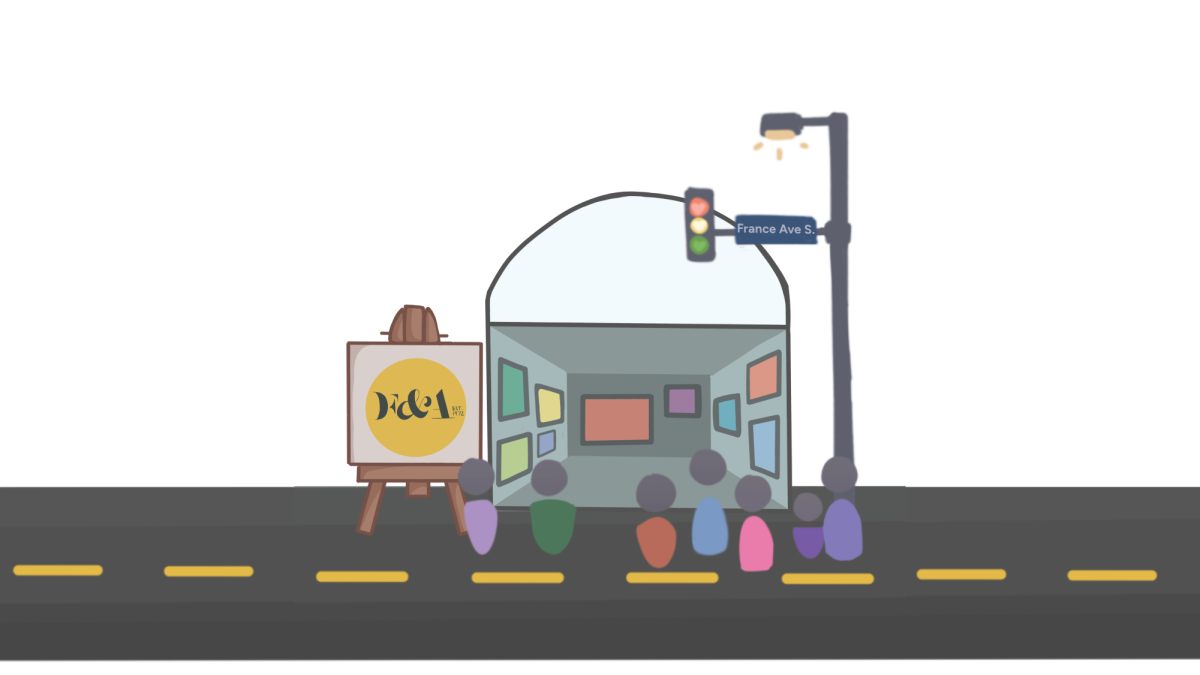
Minnesota has 61 data centers and at least 13 proposed hyperscale centers, which are larger and more powerful than traditional ones. Edina has one data center owned by DataBank located on France Ave.
In response, environmental advocacy group Clean Water Action is demanding regulation to counter the environmental cost of Minnesota data centers through taxation, transparency, and limits on centers’ energy use.
“The state of Minnesota’s electricity consumption is probably going to go up, and so we should be conscious of that,” Edina Sustainability Manager Marisa Bayer said.
In a Zephyrus survey of 443 EHS students, 25.5% said AI’s impact on the environment concerned them the most. Boruta said he researched AI in the first place because he was curious about the costs.
“We’re lucky to be in a state that has a lot of water, but that also makes us a target, a prime area to develop AI infrastructure,” Boruta said. “We need to be careful to develop it in a way that doesn’t threaten our environmental balance.”
Students and staff currently feeling the effects of AI are concerned about the increasing usage’s implications for the future. Some EHS seniors are rethinking their majors based on job market shifts caused by AI.
“AI is destroying the hope of a lot of my art students,” Towne said. “It’s all, unfortunately, about money, and companies are going to go with what’s cheaper. And if they can get away with not paying an artist and using AI, then that’s going to happen.”
Heffelbower said she also noticed this shift among her peers in her art classes.
“I’m really upset about it because art is just something that is so valuable to society,” Heffelbower said. “Artists have, I feel, never been appreciated for what they bring from the beginning, and now it’s just like AI is taking their job, which is making it even harder for artists to make a living in the world.”
When senior Ceci Jancourt considered her majors during college application season, she selected psychology as her major and English as a minor despite her lifelong interest in writing. She said she decided on a profession that focuses on interpersonal interaction because it will “always demand people and would be a more steady job that would survive.”
Similarly, senior Vincent Ronhovde changed his major out of worry for AI’s future development. Originally intending to apply as a computer science major, Ronhovde selected mechanical engineering as his major instead.
“I just don’t think [computer science] seems like a super stable idea right now,” Ronhovde said.
The Minnesota Department of Employment and Economic Development estimates that more than half of Minnesota’s jobs will be affected by AI, with 500,000 facing a high risk of major disruption.
Others are worried that AI will create a generation that lacks critical thinking skills.
“If people aren’t using their brains and making their own ideas, they aren’t gonna be able to function in the future,” Bliss said. “They’re gonna struggle.”
According to a June MIT study, people who use ChatGPT to write essays had the lowest brain engagement when compared to those who used no tools or a search engine.
“I think about it in the context of abstract thinking,” Jancourt said. “I wonder if that developmental milestone will either regress or will become a deficit in incoming generations.”
In contrast, Seaver said she believes that AI could increase critical thinking in the classroom, but only if “proper guardrails” are implemented.
Boruta said he believes the people behind AI development will shape its role in future society, and transparency is key to doing so.
“People think AI is going to outphase humanity,” Boruta said. “But the thing I know about AI is that it’s built on human systems, human information. And in that way, I don’t think it’s going to be perfect anytime soon because we, as humans, are an imperfect species.”
This piece was originally published in Zephyrus’ print edition on Dec. 18, 2025